

 |
|
HOME-STUDY BOOK ADDS SOME CHUCKLES by SUSAN L. RIFE They got busted the way traffic infractions typically occur: a momentary lapse in attention, daydreaming behind the wheel or talking to a passenger. Next thing Mardi Lang and Jason Smuk knew, the flashing lights of a law-enforcement vehicle were in the rearview mirror, and citations had been issued. Lang and Smuk are among the Floridians who opted to take a newly created home-study traffic school course rather than sit through four hours in a classroom. The "Traffic School Book!" was created by Traffic Safety Consultants, Inc., (TSC) of Northridge, Calif., as another home-study alternative to classroom traffic school. TSC also produces video/DVD and Internet home-study versions. All follow a "Funny in Florida" theme meant to help recalcitrant drivers learn more easily. "We believe the first law of communications is to get someone's attention, and the first law of education is retention," said Lawrence Gentilucci, director of operations for TSC. "Our experience has shown that using comedy as a learning tool in traffic safety education — as opposed to a dry regurgitation of facts, warnings and statistics — is more effective in getting and keeping students' attention and enabling them to absorb and retain the information." About half of Florida traffic school students now take the home-study option rather than sit in a classroom for half a day. The "Traffic School Book!" is sprinkled with jokes and cartoon illustrations. The "Funny in Florida" video/DVD home study uses video effects, computer graphics and music as the instructor plays such "characters" as Leonardo DaVehicle, Dr. Otto Mobile, Morty Motormouth and Chef François Fender Bender. A book for home-study traffic school has been around in California for 10 years but just arrived this spring in Florida, Gentilucci said. The biggest challenge in developing the program was Florida's four-hour traffic school time requirement. "We came up with a call-in requirement or a log-in requirement," said Gentilucci. Students either call a number or log into an Internet site at the beginning and end of each chapter, with an average 45-minute minimum to read each chapter. Skipping through the material won't work — so-called "validation inserts," short sentences unrelated to traffic safety, are hidden throughout the chapters. Drivers have to answer questions about the validation inserts to successfully complete each chapter and move to the next. For Jason Smuk, a massage therapist in Clearwater, who was cited for not coming to a complete stop at a stop sign, the validation inserts helped keep him from glossing over the material. "Some of them are pretty funny," Smuk said. "Some of them are completely lost on me and some of them I got. Right when I'd start to zone out, and I'd be, like, blah blah blah ... wha-?" Mardi Lang, a metallurgical technician in Geneva cited for driving 44 mph in a 25-mph zone, said the inserts kept her attention focused. "I was reading along and would say, 'That doesn't make sense.' I thought that was a good idea," she said." Smuk said the comic aspect is at least somewhat helpful. "It struck me as being OK; I could use a laugh," he said. "It was as entertaining as it could be. It was still traffic school." |
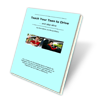 Teach Your Teen to Drive…and stay alive is a fun and
informative book that helps parents and teens to fulfill the practice driving
requirements. Order your copy (via Amazon) today and learn to
drive the easy way!
Teach Your Teen to Drive…and stay alive is a fun and
informative book that helps parents and teens to fulfill the practice driving
requirements. Order your copy (via Amazon) today and learn to
drive the easy way!